Saturday, March 16, 2013

Utilities: Actual versus Estimated

Here is some advice for every new homeowner, which is probably far more obvious to most than it was to us.

When we were close to closing, I brought up utilities to our lawyer, because I was concerned over responsibility. "You only pay for what is incurred after closing," was the response, which made perfect sense to me. I didn't question it much more.

It is not the fault of my lawyer, but I should have questioned it more.

And after my experience, my advice is very simple:

Take pictures of your meters at closing.

Every one.

I can write all of this happily now, after "fighting" for the past couple of months with utility companies since closing, but I feel most of what I went through can be easily avoided with a few simple steps.

Like most, I called all of the utility companies to set up our accounts after we closed. In some cases, it was a little more complicated since the house that we bought was a two-family - meaning two utility accounts in some cases.

What I didn't account for was that the previous owner hadn't allowed meter readings from any utility company for three years.

Because of this, all meter readings had been estimated at very incorrect levels...

I'm not sure how it is in other parts of the country, or other parts of the world, but in NYC, meters are usually fairly accessible in large apartment buildings, because the "super" will allow access. However, in other smaller residential units (small apartments or townhomes/brownstones), utility meters are often inside, even in basements, and not as easily accesible to public inspection. When access is not granted, the utility company bills based on estimates.

Thankfully, right after closing, I took pictures of our meters. I am so glad that I did. Our utilities are handled by several sources: Con Ed, National Grid, DEP. 

Certain utilities (like water) were taken care of at closing, but others were actually left fairly ambiguous. To make it a happier story, to date, we have not paid for anything we did not owe, but we easily could have, so I would caution others to be aware. 

Fortunately, I knew to be aware of the "estimated" versus "actual" reading bills. But I can easily see how someone could not pay attention for months and get themselves into trouble.

Meter readings - you should learn how to read them and take pictures. Then contact the companies.

For other utility companies, they insist on coming in person. 

While most New Yorkers can guess the company, I won't name them, but they say they will come between 7:00am and 6:30pm and give you a 30 minute "warning call" to let you know that they are own their way.... 

Many don't realize it can take more than 30 minutes to get from one part of Manhattan to another, never mind from one borough to another... Never mind we are working... 

That is a vent for another time....

While not time-sensitive, another issue for us is that we have two sets of meters in some cases because the house was set up as a two-family. We will definitely be posting on the process to convert the meters to one set as our process continues...

Insurance: What is it good for?

Homeowner's insurance. How easy, right? I mean, you see dozens of commercials each month, even on basic channels, advertising different providers of home insurance.

It may be easy to some, but to us, insurance was something fairly new and complicated. We only knew one type of insurance. Well, to put all cards on the table, I suppose we knew two types: Health insurance and renter's insurance. The first was pretty much a necessity, and the latter was something we always speculated about and never actually committed ourselves to sign up for.

Even as novice first-time home buyers, we knew we would need home insurance. However, that was the extent of what we knew. We knew it was necessary, even beyond the bank's closing requirements. However, even though our financing bank we would be doing extensive demolition of the home, they didn't specify their home insurance requirements- they really seemed to only want proof of some type of insurance.

I was very honest with the first few providers I called to get quotes. I recounted what type of work would be done to the home and immediately was told that they didn't provide insurance for homes in that condition.

Call after call.

Referral after referral.

We finally found out what we needed: Builder's Insurance and Liability Insurance.

"Obviously", some might say. Well, how were we to know? We are pretty sophisticated "googlers" and not even then could we get a clear answer.

I called the bank after hearing this and tried to confirm with them - would they accept these two insurances in lieu of traditional "homeowner's insurance". They confirmed that they simply needed to validate "insurance" and this would be fine.

I won't explicitly give numbers, as the point of this blog is to be more informational than financial, but I can affirm that these insurance policies are far more expensive than traditional homeowner's insurance. By "far more", I mean considerably more. And by considerably more, I mean... Well, how to put it into perspective. Traditional homeowner's insurance seemed to be "X" amount. This insurance was multiples more.

I guess this protected us against the home falling down, or someone walking into our demolished home and hurting themselves?

Regardless of what this policy provides, I feel it proves what most say when they start construction. Take what you think it will cost, add 30%, and if it comes in around there, feel thankful.

And we are just at the beginning. :)

Demolition Part Deux

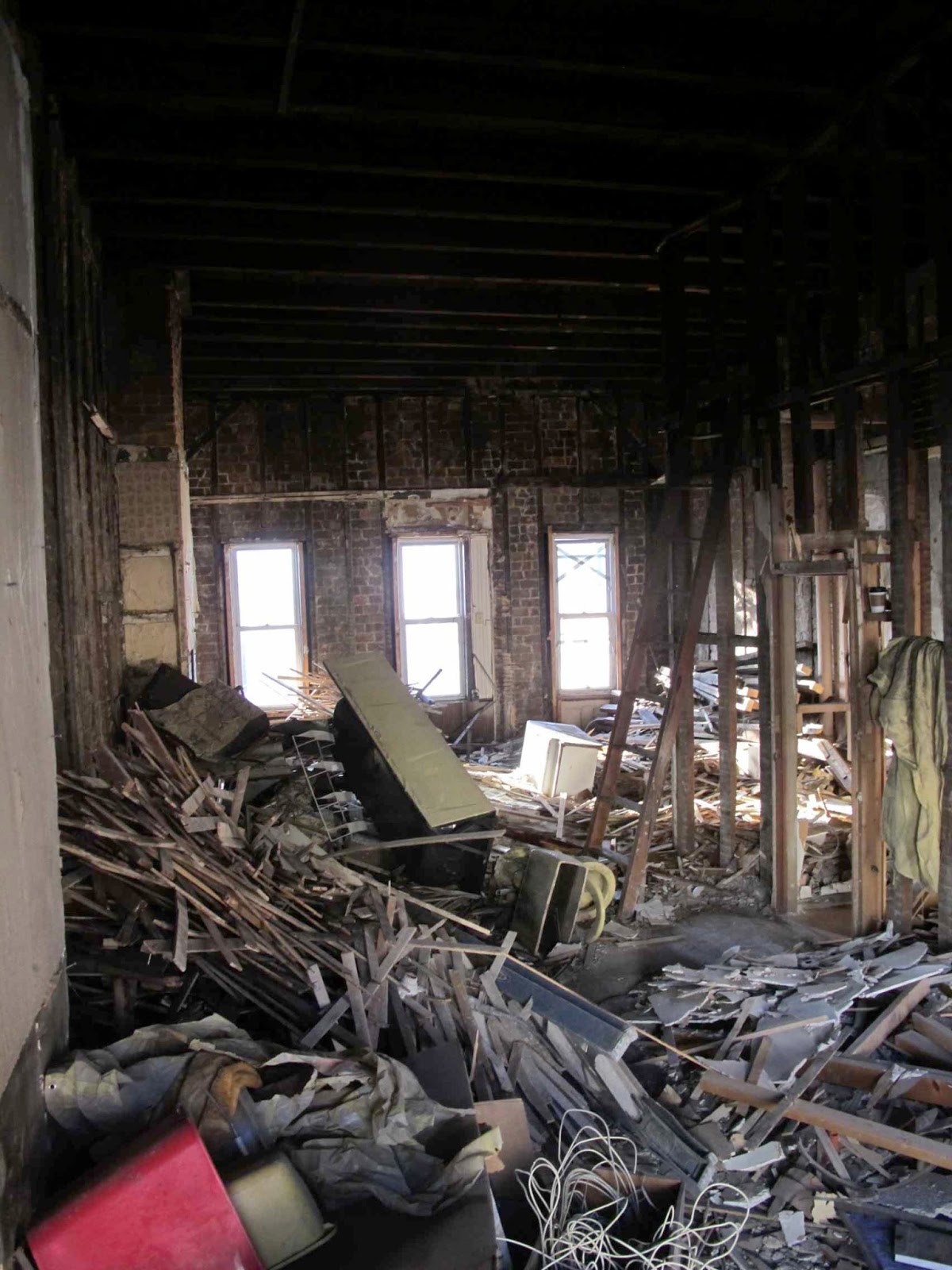
The following pictures represent the true state of demolition. For all those who question what parts of the house we might keep or what we could salvage... Well, I think these pictures pretty much represent what we are salvaging. In fact, not even entirely, since we intend to replace a lot of the beams as well.

The beauty of completely renovating a house is that you have the personal knowledge of what age and quality of materials will be hidden in your walls. This is both a blessing and a curse. Knowing everything is brand new and installed to your standards is of course a fantastic comfort. The fear of what it will take to get there, and the cost, however, is something else entirely. 

At this point, we can still smile and be optimistic. Only a handful of checks have been written, after all. 

Tonight I brought a very dear, close friend of mine to visit the property. It was the first time she had actually seen the house as she lives in Hoboken and we often catch up in Manhattan. I wish she had seen it before this state, but in actuality, post-demolition is almost an easier state to explain our visions.

We sat on the only surface available at the moment: a wooden board balanced over a few floor joists at the entrance of the house. On this shoddy surface we sat in dust and shared a bottle of wine while I showed her once again our floor plans. This time, in the raw space, the floor plans made sense. She looked around and gave me some great advice. "Next time you feel stressed, or that it might not happen," she said, "come back here, even as it is now, look around, and tell yourself what you just told me, and it will remind you why you are doing this and why it is worth it." Thank you, Annie. That is the reason I share your smile in the picture below. 


Friday, March 1, 2013

Demolition Photos.... Part 1

After closing, the road to demolition was a short one.

Many people don't understand the concept of a gut renovation, even if they think that they do. Even I had to be reminded by my husband several times. Sometimes I would make a comment or ask a question that would make him simply roll his eyes. He somehow understood from the start what it meant. I thought I did; however, it was not until I saw the property after demolition that it really hit me! 

To back up for a minute, I should mention that we did some "demolition" of our own when we first closed. The last "renovation" of this 1910 home had been when drop-down ceilings were all the rage, and we were anxious to gauge the true height of the ceilings in the home. In one evening of inspecting our newly purchased home, we took down a couple rooms' worth of drop-down ceilings and were very pleased to find the pre-war construction high ceilings that we expected. 

In any case, when mentioning the gut renovation to friends and family, and indicating our anxiety concerning the project, we were met with common responses - Couldn't we save some of the wood floors? Couldn't some of the plumbing still be used? Maybe some old materials can be salvaged?

I'll let the following pictures do their own speaking. This was mid-demolition in the middle of January 2013:


To come shortly - the pictures when demolition was recently completed in the first week of February 2013.


The Road to Closing & Closing Costs


Our original closing date was August 15, 2012. We did not close until December 7, 2012. A variety of issues contributed to this delay.

The first delay was on our part. The original contractor that we wished to use did not meet all of the bank’s requirements and was also hesitant of the 203(k) process, with all of its rules and regulations. Therefore, after submitting all of the paperwork and forms for this contractor, we wound up having to repeat the process with another contractor.

The next delays were due to the homeowners. The two-family home had been owned by the same family for decades, and the title was in the names of an older gentleman and his mother. Unfortunately, both were not in good health. The mother had been sick for a while, apparently suffering from dementia, and was in a nursing home. The son had recently been diagnosed with an terminal illness but had deteriorated quickly; soon after we signed a contract, he was also placed in a medical facility. 

This house was a two-family home, and we soon learned that a third, unrelated party was living in one of the units. We also soon learned that this man had no intention of vacating the property. After all, why should he? He was living for free, had no lease, and the owner of the home was indisposed at another location.

To make a long story short, after applying a lot of pressure, threatening to back out due to breach of contract (which stated there were no tenants), we were assured that the man was vacating. However, he refused to leave until he secured a lease elsewhere in the city. On top of this, forget the “broom clean” clause in the contract, the owners of the home left a considerable amount of junk and debris behind.


In the end, it worked out. The “tenant” vacated and we closed on the home. Thanks to our lawyer (thankfully we chose a great lawyer for closing) the homeowners had signed an agreement to pay us if certain conditions weren’t met. For example, daily charges if someone was still living there after closing, money held in escrow to ensure the place was cleaned out, etc. As they hadn’t cleaned out the place, we were able to get a bit more money from them. Additionally, we were demolition the place – after we picked out some semi-interesting “treasures” from the junk left behind, we planned to have the rest removed with demolition.

In a way, I’m not sure what was more difficult – the closing process, or paying for the closing….

Should I state the obvious? New York City is expensive. For a reason that sometimes only we understand, we pay more for just about everything (except property taxes!) so it is no surprise that closing costs are a significant expense to factor in when buying or selling a home.

One of the key reasons that closing costs are higher is the higher price of real estate. To give you an idea, our closing costs were 3.1% of the sale price of the home (excluding the cost of renovations). The NYS Mortgage Tax/Transfer Tax was 68% of this alone. In addition to this, there was, of course, the downpayment to the bank. Despite being an FHA loan, which typically requires a very low downpayment, we actually paid around 20% down because of the size of our loan including the renovation costs. The downpayment wasn’t too painful at closing since we had already been required to put down 10% when we went into contract, which is customary in NYC. 

The other additional cost was that of our lawyer. I’ve heard prices quoted from friends outside of the city that are a fraction of what we paid, and I’ve also heard of the bank actually providing a lawyer at closing.  This was not the case for us, but we were very happy with our lawyer and would definitely recommend him. It was more expensive than we originally anticipated, but that original expectation was based on a closing date in August. Since we took four months longer and there were some road bumps along the way (illegal tenant, anyone?), the price was understandable.

While the cost of closing was high, we were prepared for it, and I give credit to our bank in that regard. Wells Fargo’s “Good Faith Estimate” was well aligned with the costs incurred at closing, and everything was well explained. In any case, it is always important to do your due diligence and read everything twice (or ten times). For example, we were refunded a small chunk of change after closing from insurance that had been pre-paid at closing; since we obtained our own insurance independently and showed proof of this, this pre-payment was swiftly returned to us.

Financing and FHA 203k Loans


 Like many others, in order to purchase our home, we needed to finance a portion of it. We had saved very well in our preparation of buying a home, but we were also cognizant of the many expenses ahead of us.

After doing a lot of research, and reading many different experiences, we decided to finance with a 203(k) loan, also known as a “Rehab Loan”. For more information, here is the official website:

Basically, with a 203(k), you obtain loan larger than your traditional mortgage, because you are also financing the cost of renovating your home. It’s not as straightforward as your typical mortgage, and there is a lot of paperwork involved. It also isn’t as simple as closing on your home and getting a big fat check for the renovations needed.

The money for the renovations is held in escrow, and there is a detailed list of specific items for which the money is reserved. For example $X,XXX is specifically for floors, or plumbing, or demolition/clean-up, etc. An HUD consultant visits the home and does a thorough documented inspection before closing in order to produce the “Work Write-Up” (WWU) to detail what repairs will take place and at what cost.

Once repairs/renovations are underway, the same HUD consultant returns periodically to do further inspections. When progress is made, you receive payment from the bank from the escrow account through the draw process. A small portion of money is held until the end of the renovation, when they sign off that everything is complete. At that point, the money is either released to you in order to complete payment for the balance of the renovation cost. Any excess (seriously?) would be applied to the principal of the loan.

Seems easy, right? Not quite. In order to close on the loan, a lot of decisions and commitments need to be made. There are things that you wouldn’t have even thought of at this point in the process with a normal mortgage, even if you intended to make renovations to your home. For example, you need an architect and a contractor.

The contractor needs to be officially approved by the bank in order to close on the loan. They need to agree to the WWU and sign it in addition to a number of other forms and releases. They need to prove their licensing, their financial ability to complete the work (remember, funds are not release until progress/completion), and a number of other requirements. You can change your contractor after closing, but to do so is another time consuming and challenging process.

The other tricky requirement is timeline. The bank requires you to complete the renovations in six-months. For a full gut renovation, that is a large task! Additionally, we are in New York City. The Department of Buildings (DOB) here is strict and attentive. You need permits for nearly every type of job, and you have limitations to when work can be done. Since the type of permits we need could take months to be approved, we have already spoken to our consultant about extensions to the six-month requirement. We have been told not to worry about it. Delays that are out of our control are not penalized.

In the end, we were eventually approved and the bank was happy to close. However, approval from the bank is only one part of the closing process…

Pictures of the Fixer-Upper....

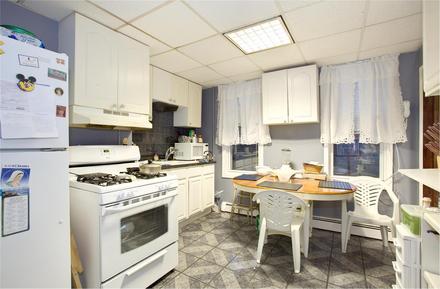
While the pictures of the house in its originally purchased state do not represent a glamorous property, to us they do represent the raw potential and imagination behind our purchase. Curb appeal, updated appliances, luxury finishes, chef's kitchen... None of those real estate catch-phrases could possibly be applied to this particular address! Not to mention that the two-family configuration and drop-down ceilings makes the space feel far from spacious.

However, these pictures do serve as a fun reminder of the "before." Hopefully we survive the process (and don't run out of money!) to finally compare it to the "after."